
A Waterbedtime Story™ sponsored by InnoMax Corp.
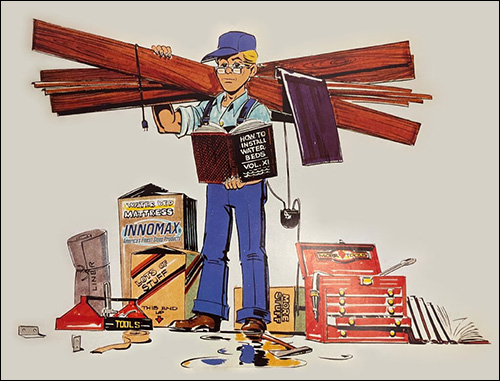
In the early 1970s, a curious bedroom accessory began to emerge from the fringes of American counter-culture: a mattress filled with water. The waterbed—initially appearing in head-shops and hippie hang-outs—invited sleepers to immerse in fluid suspension slumber. In those early days, many of the earliest owners built their own frames out of 2” × 10” inch lumber—a rectangular “Hardside” box, bolted or screwed together with plywood decking under the mattress binding the frame together for structural integrity.

Evolution: platform frames, pedestals and drawer bases

As the waterbed phenomenon matured, so too did the frames. The early “DIY lumber box” gradually gave way to more formally manufactured Hardside frames and furniture. Furniture-builders then began designing platform styles whereby the water chamber would sit on a pedestal base, sometimes with built-in drawers underneath, or on raised pedestals to offer storage space beneath. Meanwhile standardization of Hardside fluid mattress sizes emerged: King ~ 6′ (72″) width by 7′ (84″) length, Queen ~ 5′ (60″) width by 7′ (84″) length and Super Single ~ 4′ (48″) width by 7′ (84″) length all accommodating an 8” Waterbed Depth (water fill height). Over the decades, headboards, side rails, padded cap-rails—all continued evolving to include wall beds, platforms and other innovative designs that found their way into conventional furniture and home stores.
Standardization of the Hardside mattress and accessories

Parallel to frame evolution, the waterbed mattress and its technical components became standardized as well. As demand grew, mattress manufacturers settled on common dimensions and accessories so that frame-builders and retailers could target known widths, lengths and depths for companion Safety Liners. This also helped establish performance standards for waterbed heaters as it quickly became evident that 300 Watts was the minimum power level required to keep a King Hardside waterbed warmed to skin temperature in a 70°F ambient temperature room. And as the National Weather Service defines water as cold if it’s 70°F or lower, or as anyone jumping into a 70°F or pool can tell you, because the human body loses heat about 25 times faster in water than in air, waterbed heaters are designed to maintain a comfortable water temperature compatible with human skin temperature at 85°F.
Continuity today: DIY and adjustable support options

The advent of Waterbed Mattress Kit Bundles provide consumers everything needed to fill, drain and maintain their waterbeds. Containing fill & drain hose kits compatible with ordinary garden-hose threads and adapters to connect via indoor kitchen or bathroom faucets, complete bundles include the waterbed mattress chamber, standup safety liner, waterbed heater and fill & drain hose kit. And in addition to other enhancements such as mattress pads, electric drain pumps and air bubble burping devices, contemporary Waterbed Mattress Kits offer a variety of performance options. Starting from the original Free Flow chamber designated as the Full Wave model and including varying degrees of wave reduction up to 99% Waveless models. Other features can include dual lumbar support and overcut impression tops with low tension contouring support.
Fast forward
Fast-forward five decades on and the industry infrastructure support remains robust with companies such as InnoMax Corporation (established 1975) continuing to produce complete turnkey waterbed sets as well as Waterbed Mattress Kit Bundle modules—inviting aspiring furniture designers to: “Just Add Frame and Water”.

Irvin Saathoff for InnoMax Corp.

Contributing author for this edition has been Irvin Saathoff a waterbed sleeper since the 1970’s who has been working in InnoMax R&D for the past 20 years. Check back in with the next episode of Waterbedtime Story™ when we share yet another perspective. In the meantime please feel free to connect with InnoMax Corporation anytime at Sleep@InnoMax.com.